
What stands out to me in the current international conflict is how human cognition is being played with — especially through:
1) Appeal to incredulity fallacy for self-victimization; and
2) Political gains driven by nationalist fervor.
1️⃣ The fallacy of “Come on, who would ever do something like that?!” — used to justify a victim role 😇😈🥺👹
We’re seeing claims from one side along the lines of: “We’re smaller, weaker, and recently war-torn — why would we start a war?”. This is a textbook appeal to incredulity — a logical fallacy where one uses the unlikelihood of something to assert its falsehood — and in this case, it’s used to support self-victimization, framing that side as the one that must have been attacked first. 🎭🤹🏻♂️
I have personally experienced how some people exploit this tactic to legitimize and cover up their own wrongdoing 😶🌫️—distorting the truth in a way that ultimately downplays the severity of the harm they caused to my life. 🫥🫠 It happened when I was forced to move out of my own home just as I was beginning my second master’s degree and appeared set to succeed.
Despite repeated efforts to address the issue peacefully, the behavior I faced made it impossible to continue living together in the family home, and yet I was met with blame and questions from relatives like: “Why did you even have to leave?” The perpetrator went around crying and lamenting to others, as if they were the victim harmed by my moving out, and by how I intentionally chose to become homeless because of their actions. (What a logical mess?! 🤯) — an act of manipulation that fueled further blame toward me.
This moment marked the beginning of a long stretch of hardship that deeply impacted my physical health, mental stability, and life opportunities. (Though, in retrospect, it also clarified people’s true place in my life 👍🏼 — especially their level of discernment and sense of fairness when confronted with nearby injustice. ⚖️💎🪬)
What struck me most was how quickly some people in general clung to the narrative that seemed more believable (in my case, “a family member would never do that!” 🤷🤷♂️🤷🏻♀️) That assumption alone led them to jump to the conclusion that the other party must have been at fault. And now, we are witnessing the same type of fallacy being deployed on an international scale.
2️⃣ The Political Gains Driven by Nationalist Fervor – Provoked by Perceived External Enemies 🧲⛓️⚔️🛡️
When a conflict with outside entities emerges, people instinctively seek inner unity in the face of a shared enemy. And in cases of interstate warfare, this tends to stoke nationalist sentiment ❤️🔥, which inevitably benefits internal power factions on both sides of the conflict. 🧮💣
It reminds me of Watchmen, where Ozymandias fabricates an apocalyptic threat from outer space 👽🚨 — the only way to stop humanity from endlessly waging wars and turning its weapons on itself. 🩸💢
In such situations, the beneficiaries are political polities that control the means of violence — the military, weapons infrastructure, and security apparatus. The surge in ideological nationalism legitimizes their grip over those resources, reinforcing their hold on political dominance in the long run. ♟️🏹🏛️🔥🕊️👑
📍Fundamentally, human cognitive patterns are critical during large-scale conflicts like this, as they shape the flow of benefits and the path societies take.
To systematically prevent and reduce the possibility of violence, I’ve stated in a previous post:
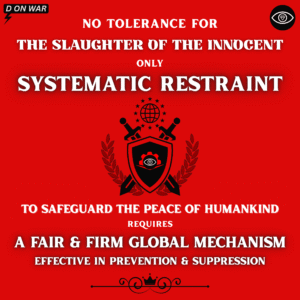
Unless there exists a global enforcement mechanism that raises the cost of initiating aggression, humanity will never be safe from the slaughter of the innocent.
Still, under the sway of cognitive influence, whether we can collectively reach that point remains uncertain — and this is precisely why Wizdomkult must exist 💫:
To question, to expose, and to illuminate the structures of thought that shape our world. ⚡️
Find on: