
Finding the Middle Ground for Sustainable Cooperation in Regional Development
⭐️ Overview
As a source of immense global interests, the South China Sea represents a world-scale conflict situated in my home region of Southeast Asia. It involves multiple actors: extra-regional superpowers such as the United States, the emerging superpower China located within the region, and several small claimant states in ASEAN.
Studying this issue reveals the intricate interplay of power and interests on a global scale—an entanglement that provides invaluable insights into understanding human conflicts as well as pathways toward resolution.
In conflicts where the parties possess unequal power, it is essential to understand the asymmetry in power bases in order to negotiate effectively. In this regard, I propose that, within the context of the South China Sea’s power rivalry between global superpowers, small states can unite to bargain collectively with the major power claimants by leveraging the balance of power between the two giants to their advantage. This perspective stems from the study of international political theory on power.
As for solutions, this work emphasizes the importance of understanding the differing initial interests of each party, each with its own rationale for claiming rights over this highly valuable sea. The aim is to integrate these interests and find a middle ground acceptable to all sides. This proposal is presented across six dimensions: politics, economy, society, technology, environment, and law (PESTEL).
The ultimate goal is to foster regional cooperation in developing the South China Sea based on the principle of sustainability—overcoming the long-standing conflicts that have hindered humanity from making full and equitable use of the planet’s resources.
— Dom K.
de la Wizdomkult
🌏🪢🌟🌏🪢🌟
⚡️ Introduction
The intricate and potent relationship between power and interests lies at the heart of human society. Throughout history, societies have been driven by a relentless pursuit of power in various forms to secure tangible benefits and strengthen their security. ‘Power’ refers to the ability to bring about desired outcomes, grounded in relationships among actors with unequal power. This inequality has long existed across all levels of human society—from interpersonal relations to interactions between nation-states (Dahl, 1957: 201–203; Russell, 1996: 1–22). On the macro level, power dynamics manifest most significantly in international relations, particularly among great powers whose interactions shape the global order and influence how resources are distributed across the world. This reality fuels ongoing efforts to amass and compete for power in ways that maximize national interests (Russell, 1996: 178).
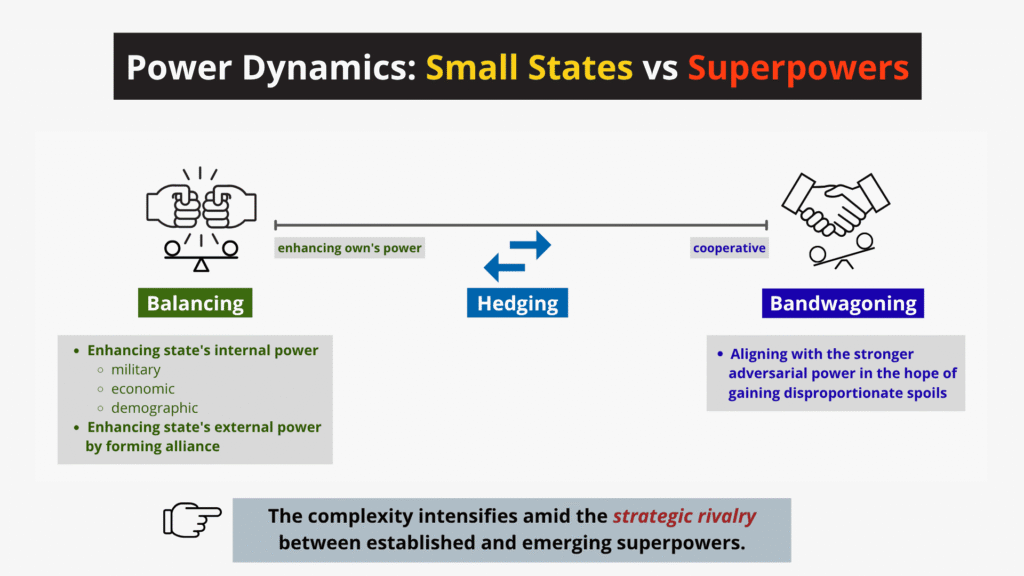
A critical case that vividly illustrates this global contest for power is the South China Sea dispute. This region holds significant geopolitical and geoeconomic value for both global powers and smaller regional and extra-regional states. Geographically, it lies in a zone dominated by China, an emerging global power, and overlaps with strategic territory long influenced by the United States, a traditional superpower. Compounding this is the maritime boundary conflict between China and smaller Southeast Asian nations—an ongoing tension that has opened space for U.S. power projection in the region (Buszynski, 2019). As such, the South China Sea serves as a prime case study for analyzing the complexity of power competition through the lens of international political economy (IPE), highlighting a web of actors driven by conflicting interests.
Studying this case not only aids in formulating viable conflict-resolution approaches specific to the South China Sea but also deepens our understanding of the broader structural dynamics of international relations, especially in settings where power rivalries persist. By doing so, we may uncover new pathways for fostering cooperation even amidst enduring strategic competition.
To explore the South China Sea issue through the IPE framework and develop constructive solutions, this essay is divided into two main parts. The first part surveys the historical background and current dynamics of the conflict, focusing on the entanglement between two major powers and smaller regional states in a geopolitically strategic area. The second part presents possible resolutions to the conflict, emphasizing mutually agreeable negotiation strategies. This analysis draws on the PESTEL strategic framework—which covers six key dimensions—to generate comprehensive, multi-faceted policy proposals. Ultimately, this essay aims to harmonize divergent interests across stakeholders to build sustainable regional cooperation.
PART I: Tracing the Origins and Current Dynamics of the South China Sea Dispute
📍 Entanglement of Major Powers and Regional States at a Global Geostrategic Flashpoint
1.1 The Significance of the South China Sea: A Coveted Zone of Strategic Value
The South China Sea is of immense geopolitical and economic importance at both regional and global levels. Economically, it serves as a vital maritime trade route, through which approximately one-third of global trade passes. It is also a key conduit for global crude oil shipments, which are essential to the economic stability of many countries. Additionally, the South China Sea holds significant natural marine resources, including valuable fisheries and energy reserves (ChinaPower CSIS, 2016; AJOT, 2018).
Politically and strategically, the South China Sea functions as a semi-enclosed sea linking the Indian and Pacific Oceans. On one side lies the United States, a long-standing global power, while on the other lies China, an emergent regional and global force (EIA, 2019; Li, 2015: 98; Buszynski, 2019: 70–73). The strategic centrality of this location makes the region a physical locus of global power balancing between these two great powers—one established and the other rising (Teixeira, 2021).
Beyond this bilateral rivalry, the region is also characterized by overlapping sovereignty claims among various Southeast Asian states, primarily over island groups with complex geophysical features (EIA, 2019). These overlapping interests, combined with the South China Sea’s multi-dimensional significance, have transformed the region into a focal point of global geopolitical tension, where various actors interact through power-driven agendas.
1.2 The Evolution of Conflict: Overlapping Sovereignty Claims and the Pursuit of Power
The roots of the South China Sea conflict trace back to the early 20th century, a time marked by imperial dominance over Southeast Asia. During this period, China faced foreign incursions and territorial losses at the hands of colonial powers. In response, both China and its colonial counterparts asserted sovereignty over parts of the South China Sea, leading China to publish maps featuring the now-famous U-shaped line encompassing the majority of the maritime area (Hayton, 2019; Zou & Ye, 2021: 124–125).
In the latter half of the 20th century, several smaller coastal states also began asserting claims over the same contested areas. The conflict gradually intensified as these nations escalated their assertions, leading to the occupation of various islands, often through military means. China, in particular, engaged in repeated clashes with smaller claimant states. This pattern of conflict has persisted in various forms into the 21st century (Tønnesson, 2020: 9–10; Tønnesson, 2021: 36–38).
The dispute reached a legal and diplomatic climax in 2013 when the Philippines filed a case against China at the Permanent Court of Arbitration (PCA). In 2016, the PCA ruled in favor of the Philippines, stating that China’s nine-dash line claim was inconsistent with international law. China, which refused to participate in the proceedings from the outset, rejected the tribunal’s ruling outright (Foreign Policy, 2016).
Since the initiation of the legal case, China has rapidly expanded its presence in the South China Sea. It has constructed over 3,200 acres of artificial islands and engaged in systematic militarization of the area—developments that no other claimant has been able to effectively counter (AMTI, n.d.; Grossman, 2020).
On one level, the overlapping sovereignty claims reflect each country’s effort to accumulate power and outmaneuver rivals over limited resources. In such a context, each state seeks to secure as much as possible to fortify its strategic footing. However, this drive for dominance risks trapping nations in an endless cycle of power competition. The militarization of the South China Sea—fueled by zero-sum strategic logic—has constrained opportunities for more constructive, resource-based cooperation.
What is most concerning is that international legal mechanisms have thus far proven ineffective in resolving this power-based rivalry. Legal rulings have not addressed the core drivers of the conflict, nor have they succeeded in curbing the militarized behavior of the dominant actor. This points to the need for a more comprehensive and pragmatic approach—one that goes beyond legalism to engage with the deeper structural forces at play.
1.3 A Global Arena of Power Struggles: Strategic Competition Between Superpowers — A Deadlock with No Way Forward
Beyond the disputes among directly involved claimant states in the South China Sea, the conflict becomes further complicated by the involvement of an external global power—the United States—whose role is crucial in shaping the region’s geopolitical dynamics. U.S. engagement in the South China Sea aligns with its broader strategic goals, evolving in response to China’s growing power as a rising challenger. Over time, as China has rapidly expanded its capabilities, especially in the military sphere, the United States has responded by increasing its own presence and cooperation with regional allies that oppose China’s claims.
Given the vast power asymmetry between China and the smaller Southeast Asian claimant states, U.S. military involvement serves as a critical counterbalance, preventing an outright Chinese advantage in the dispute (Li & Atmakuri, 2021; Li, 2015). From this perspective, the U.S. efforts to maintain its global supremacy—by countering China’s rise—have inadvertently benefited smaller states by curbing unchecked Chinese expansion in the South China Sea.
Nevertheless, the resulting power dynamic is one of strategic tension: both China and the U.S. feel compelled to escalate their power projection in response to the other’s moves, while simultaneously trying to avoid full-scale conflict. Neither side wishes to trigger a violent confrontation that could lead to significant loss on all fronts. Additionally, both superpowers must maintain their relationships with smaller regional players to preserve influence, further limiting their options for unrestrained action.
This strategic deadlock—where neither party can advance nor retreat without cost—suggests that only smaller states may have the flexibility to initiate genuine dialogue. Unlike the U.S. and China, which are locked in mutual strategic suspicion, smaller nations are not bound by the same constraints. This makes them uniquely positioned to foster cooperative negotiations that could yield mutually beneficial outcomes.
1.4 Multilateral Mechanisms for Regional Stability: An Ongoing Struggle for Consensus
Despite persistent tensions, there have been sustained efforts among regional actors to reduce conflict in the South China Sea, especially through multilateral diplomacy. A primary example is ASEAN’s engagement with China, aimed at finding a common framework to manage disputes. However, progress has been slow and inconsistent. This is largely due to diverging national interests among ASEAN member states—shaped by their geography, varying levels of involvement in the dispute, and bilateral ties with major powers like China.
ASEAN’s consensus-based decision-making model makes it difficult to reach unified positions, particularly when member states are unevenly affected by the conflict. This lack of internal cohesion has undermined efforts to establish an effective Code of Conduct (CoC) for the South China Sea, a document intended to promote peace and stability (Beckman & Dang, 2021; Son, 2020).
Still, the very existence of these diplomatic efforts signals potential for eventual cooperation—if mutual interests can be aligned. Multilateral mechanisms like ASEAN offer smaller nations a platform to amplify their voices and enhance bargaining power amid global power rivalries.
🌏🪢🌏🪢🌏🪢
The overall examination of the South China Sea case here reflects the competitive accumulation of power according to each party’s capacity—a feature that may be an inherent aspect of human society which we cannot yet deny. At the same time, it points to opportunities within the balance of power between the world’s two major powers, enabling smaller states to unite and enhance their bargaining power. Such cooperation, however, can only be achieved when there is recognition of shared interests grounded in an understanding of the differing starting positions—an issue to be elaborated upon in the following section.
PART II: Approaches to Resolving the South China Sea Conflict
❣️ Overcoming Conflict, Integrating Interests from Divergent Starting Points, Toward Regional Cooperation and Development
Given the conflicting interests among the involved parties in the South China Sea dispute, it is unsurprising that consensus on appropriate management measures remains elusive. Moreover, some issues are inherently sensitive or lack points where all parties can fully achieve their objectives. Therefore, negotiations must involve compromises aimed at reaching a middle ground acceptable to all, which is essential for successful agreements.
If accomplished, such agreements would not only reduce conflict risks and enhance regional stability but also pave the way for cooperation that sustainably benefits all parties at both regional and global levels.
To achieve this, multilateral negotiations involving all stakeholders are imperative, emphasizing the design of mechanisms for the efficient and fair allocation of societal resources aligned with each country’s capacity and stake in the dispute.
This approach leverages the power balance between the two superpowers contesting this strategically significant area, encouraging them to cooperate by acting as checks and balances that prevent any side from exercising unchecked dominance while also taking leadership or supportive roles in regional development.
🌟 Development Direction and Shared Interests: Anchoring on Regional Sustainable Development
To establish shared positions based on common interests, the principle of regional sustainable development should be the foundation. This entails a holistic development model encompassing human quality of life, economic growth, and environmental protection, with a focus on long-term impacts (Scheyven et al., 2016).
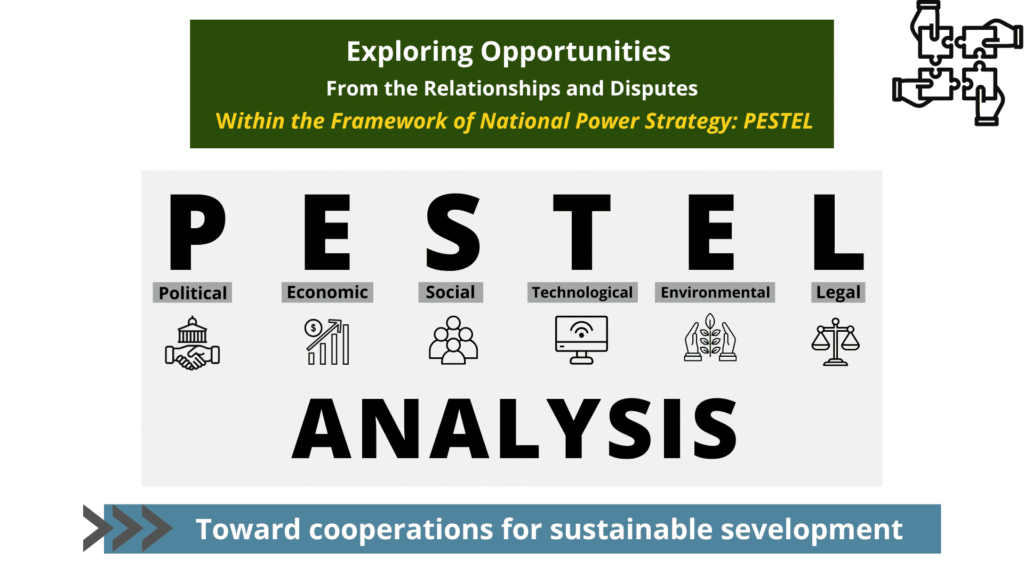
For exploring opportunities and proposing negotiation frameworks aligned with sustainable development, this section adopts the PESTEL strategic framework, which covers six key dimensions: 1) political, 2) economic, 3) technological, 4) social, 5) environmental, and 6) legal.
All six dimensions are crucial components in the South China Sea case and must be considered to address existing challenges and elevate cooperative development efforts.
Central to this approach is seeking common ground through multilateral mechanisms, where all parties can find overlapping interests.
1) Political Dimension: Establish Minimum Protocols for Ambiguous Territorial Areas, Limit Military Roles
While China opposes multilateral agreements covering both disputed and bilateral conflict areas, smaller claimant states demand comprehensive coverage. To find a middle ground, minimum operational protocols could be set for all relevant areas, with specific categories for disputed zones to enable context-sensitive management.
Regarding military roles, China insists on exclusive veto power to restrict external military involvement, whereas smaller states seek alliances with external powers to balance China’s regional dominance.
To maintain regional security stability and reach compromise, all parties should limit military activity except where credible security threats exist. In such cases, justification must be reported, identifying acts undermining regional security. This approach empowers smaller states’ security without escalating unnecessary military tensions. Robust, inclusive mechanisms must be designed for effective oversight.
2) Economic Dimension: Jointly Utilize Regional Resources, Enhance Efficiency through External Competition
China resists allowing outside parties to profit from regional resources, whereas smaller claimant states, with less economic power, advocate for external investment competition to prevent Chinese monopolization, which could undermine their bargaining power.
A middle ground could open competition, prioritizing regional investors first, permitting external investors only after justifying their cost-effectiveness and superior resource utilization. Mechanisms should be designed for collective review of proposals, identifying improvements for regional resource management.
3) Social Dimension: Guarantee Human Security
To enhance human security amid territorial disputes and legal ambiguities, mechanisms must be established to prevent threats to life, enabling offenders to face legal action with clear punitive guidelines. To gain mutual acceptance, prosecutions may occur domestically, with transparent international observation and reporting. Contingency mechanisms should address non-compliance.
4) Technological Dimension: Support Technology Aligned with Capacity, Enable Sustainable Power Projection
Instead of focusing on military technology development, the more capable superpowers could provide technological support benefiting regional members under sustainable development principles. This offers an opportunity for superpowers to build strong regional influence by leading development efforts. Jointly designed, transparent, and effective mechanisms should facilitate this role both within and beyond the region.
5) Environmental Dimension: Develop Environmental Oversight Mechanisms, Transform Power Competition into Development Competition for the Planet
Twofold environmental management mechanisms are needed: preventing and addressing environmental degradation, and promoting collaborative development. Similarly, superpowers with greater financial, technological, and knowledge reso
6) Legal Dimension: Establish Legally Binding Agreements on Agreed Issues, Design Multilateral Checks and Balances
To ensure fair implementation of all above aspects and related issues, enforceable legal frameworks are essential. Issues with initial consensus should be legally binding, while ambiguous matters require further negotiation and specification, with participation scaled by stakeholders’ interests.
To enhance transparency and fairness while maintaining acceptability, third-party observers should act as witnesses and issue statements on dispute resolutions.
💫 Conclusion
From the summary of cooperation approaches across these six dimensions, it is clear that each actor can participate according to their capacity and level of stakeholding—whether regional countries, major powers inside and outside the region, or international institutions. The role of each actor is crucial to consider in designing a fair and effective multilateral mechanism suitable for managing the various aspects related to the South China Sea case. This is done through efforts to find a middle ground that all parties can accept and benefit from, as outlined above.
Examining the South China Sea case through the lens of international political economy reveals the power interactions among stakeholders, clarifying the linkage between resource-based interests and motivations for power accumulation. These factors jointly drive the decision-making of each actor within the international system. Such understanding, combined with recognizing the opportunity for negotiation at the strategic juncture of great power competition, provides a foundational starting point for developing proposals to address the long-standing mismatch of interests among parties in the South China Sea.
To resolve these inconsistencies, it is essential to comprehend the divergent initial interests rooted in the differing geopolitical and economic contexts of each country and to seek a middle ground on which all parties can agree. This would enable the design of a robust multilateral oversight mechanism that not only mitigates conflict levels but also promotes sustainable cooperation for regional development. Ultimately, this approach can transform the South China Sea into a global resource benefiting humanity, free from the constraints of ongoing disputes.
References
AJOT. (2018). ‘More than 30% of global maritime crude oil trade moves through the South China Sea’. Accessed 28 January 2022 from www.ajot.com.
AMTI. (n.d.). ‘China Island Tracker’. Accessed 28 January 2022 from amti.csis.org.
Beckman, R. and Dang V. H. (2021). ‘ASEAN and the South China Sea’. In Routledge Handbook of the South China Sea, ed. Zou, K. Routledge.
Buszynski, L. (2019). ‘The South China Sea: an arena for great power strategic rivalry’. In Building a Normative Order in the South China Sea: Evolving Disputes, Expanding Options, ed. Thuy, T. T. et al. Edward Elgar Publishing.
ChinaPower CSIS. (2016) ‘How Much Trade Transits the South China Sea?’. Accessed 28 January 2022 from chinapower.csis.org.
Dahl, R. A. (1957). ‘The Concept of Power’. In Behavioral Science, 2(3): 201-215.
EIA. (2019). ‘South China Sea’. Accessed 28 January 2022 from www.eia.gov.
Foreign Policy. (2016). ‘Why China Says No to the Arbitration on the South China Sea’. Accessed 28 January 2022 from foreignpolicy.com.
Grossman, D. (2020). ‘Military build-up in the South China Sea’. In The South China Sea: From a Regional Maritime Dispute to Geo Strategic Competition, ed. Buszynski, L. and Hai, D. T. Routledge.
Hayton, B. (2019). ‘The Modern Origins of China’s South China Sea Claims: Maps, Misunderstandings, and the Maritime Geobody’. In Modern China, 45(2): 127-170.
Hayton, B. (2021). ‘After 25 Years, There’s Still No South China Sea Code of Conduct’. Accessed 28 January 2022 from foreignpolicy.com.
Li, J. (2015). ‘China, the US, and maritime security in East Asia: A Chinese perspective’. In New Dynamics in US-China Relations: Contending for Asia Pacific. Routledge.
Li, M. and Atmakuri, A. (2021). ‘US-China rivalry in the South China Sea’. In Routledge Handbook of the South China Sea, ed. Zou, K. Routledge.
Pedrozo, R. (2021). ‘Is a South China Sea Code of Conduct Viable?’. In International Law Studies, 97: 937-955.
Russel, B. (1996). Power: A Social Analysis. Routledge.
Scheyven, R. et al. (2016). ‘The Private Sector and the SDGs: The Need to Move Beyond “Business as Usual”’. In Sustainable Development, 24(6): 371-382.
Sons, H. S. (2020). ‘ASEAN and the South China Sea’. In The South China Sea: From a Regional Maritime Dispute to Geo Strategic Competition, ed. Buszynski, L. and Hai, D. T. Routledge.
Teixeira, V. A. G. (2021). ‘The Hegemony’s Contest in the South China Sea’. In SAGE Open, July-September: 1-15.
Thayer, C. A. (2020). ‘ASEAN, China, and the Code of Conduct’. In The South China Sea: From a Regional Maritime Dispute to Geo Strategic Competition, ed. Buszynski, L. and Hai, D. T. Routledge.
Tønnesson, S. (2020). ‘Four aspects of the crisis in the South China Sea’. In The South China Sea: From a Regional Maritime Dispute to Geo Strategic Competition, ed. Buszynski, L. and Hai, D. T. Routledge.
Tønnesson, S. (2021). ‘The South China Sea: historical developments’. In Routledge Handbook of the South China Sea, ed. Zou, K. Routledge.
Zou, K. and Ye Q. (2021). ‘The U-shaped line and its legal implications’. In Routledge Handbook of the South China Sea, ed. Zou, K. Routledge.
Adaptation Notice & Acknowledgments:
This essay won 1st place🥇 from the American Studies Association and the US Embassy in Thailand‘s Essay Competition on ‘The South China Sea Disputes and Possible Solutions’ (2022).

The essay was adapted from an in-depth full paper titled ‘Exploring the Power of Small States Amidst Great Power Rivalry: Philippines and Opportunities for Multilateral Negotiation via ASEAN on the South China Sea Towards Cooperation in Sustainable Regional Development’ submitted in completion of the course International Political Economy offered as part of the MA Program in Political Economy at the Faculty of Economics, Chulalongkorn University.
The course was taught by Assoc. Prof. Piti Srisangnam, PhD, whose valuable advice has helped improve the paper. The professor has been an inspiration in applying academic thinking beyond ideological bias, encouraging me to consider conflict issues more comprehensively. This broader perspective is crucial for effectively resolving conflicts where the involved parties have conflicting interests.
Find on: